Week 5 of the PRO Chess League featured inter-league play between the forty-eight teams across the world. The matches took place on a Saturday to make it easier to accommodate time-zone changes, which resulted in a 10:20am start time for Carolina. The Cobras were paired with the Amaravati Yodhas, another young team based out of India. With both teams sporting comparable rating averages, one could predict a close and interesting match.
In our first legitimately tight match of the season, the Cobras defeated Amaravati by a score of 8.5-7.5. Carolina's lineup included FM Robin Cunningham and NMs Peter Giannatos, Daniel Cremisi, and me. It was a balanced effort by the four of us, as no player scored more than 2.5 points.
This week's game analysis will be a little bit different from past weeks. Instead of featuring everyone's best or most exciting game, I thought it would be interesting to show all of our games from the last round, as we attempted to clinch the match. The first three rounds had produced a 6-6 score, making the final games extra tense. None of us wanted to let the team down by losing our final game. I'm hoping that my analysis below will shed some insight into some of the unique considerations that go into team matches as opposed to individual chess.
NM Daniel Cremisi kicked off the final round with an effortless win as black. Anyone who has played Daniel would not be shocked to learn that his opponent flagged while Daniel still had over two thirds of his time remaining. Daniel has been a strong rapid player the entire season, and he came through again this week with a score of 2,5/4. His game featured a series of blunders by his opponent, which Daniel easily exploited.
Since Daniel's game finished first, the rest of us were all under significantly less pressure. Our goal remained to play solidly, and make sure not to lose. Draws essentially were as good as wins.
FM Robin Cunningham scored a solid 2/4 in the match. His last round game was relatively mundane, ending in a quiet rook ending draw after many of the pieces were exchanged early. Knowing that the most important thing was to avoid losing, Robin played with as little risk as possible.
NM Peter Giannatos scored 2.5/4 for the Cobras, and it could have been even more if not for a round two swindle in a time pressured ending. His last round, like Robin's, was the epitome of cautious flexibility, as he maintained a solid position while preserving chances to press depending on what the team situation required.
With the team score at 8-7, I needed to draw my last game for the team to win the match. I had only scored 1/3 in the first three rounds, as my play had been highly inconsistent. After am interesting struggle, I managed to draw the game below, clinching the match for the Cobras.
The narrow victory gives Carolina a 2-3 record on the season. Our next match is Wednesday, 2/15 at 6:45pm against the Atlanta Kings.
I hope you enjoyed this recap! Until next time,
LM Aaron Balleisen

Sunday, February 12, 2017

Friday, February 10, 2017
Simple Chess: Bullet, Blitz, and Onward.

A lot of higher rated players will tell you that playing a lot of blitz and bullet chess will not improve your chess. Even more people will tell you that analyzing your bullet and blitz games is useless. While I agree that it will hurt you if all you play is bullet and blitz, I think that there is a time and a place for both speeds of chess to enhance and improve your tournament play with the correct mindset.
I will explain my reasoning for using both methods of the faster time controls.
Bullet
When I talk about bullet, I am specifically talking about 1 minute chess. I use this method to continue to work on seeing simple tactics (hanging pieces, forks, pins, skewers, bank rank mates). Bullet chess also helps when you play long tournament games and you get down to only a few minutes or seconds on your clock. It takes away the panic of only have a minute on your clock because you are used to playing entire games in only a minute.
Blitz
When I talk about blitz, I am specifically talking about 5 minute chess. I use this method to work on practicing my openings and also with tactics. After a few games in my openings, I will compare with my database to see where the opening left the book/plans of the opening. This is a great way to not only increase opening knowledge but also making it more relevant.
Onward
With all of the above points, I have to caution you from ONLY playing bullet and blitz. You have to play slower time controls. I play 45|45 or 90|30 games through a Slow Chess League on Chess.com. This way I practice actually playing slower and taking my time during my moves. Also playing once a week at the Charlotte Chess Center with a 75|15 time control.
I used to play bullet and blitz with the intention of just playing, but once I switched my mindset to these reasons it has improved my chess time management during long time controls. I have no doubt this will help improve your chess as well.
Until next time,
David
Wednesday, February 8, 2017
The One That Got Away
 A total of 28 players played in the third round of Tuesday Night Action 30. On the top board, Gary Newsom(2014) grabs the lead after three rounds with a shocking win over Vishnu Vanapalli(1975).
 Meanwhile, a heated contest occurred on board two. The previous Tuesday Night, there was debate between Grant Oen(2147) and Patrick McCartney(2131) over the soundness of the King's Indian Defense, Grant claiming he could take it down with the Classical Variation while Patrick claimed it was a perfectly viable defense and one he'd have no problem playing against anybody. Needless to say, a Classical King's Indian is what was played, and Black successfully broke through the blocked position to reach a complete winning position by move 32. Only one problem. Black's working off the increment for the rest of the game. This resulted in a number of missed tactics by Black to end the game on the spot, but instead it dragged on, and finally on move 65, after more than 30 moves at a rate of 15 seconds per move, Black finally cracked, and turned a won game into a draw. Instead of being able to take the White King down, it became a case of "the one that got away". The game can be viewed below:
Elsewhere in the top section, Aditya Shivapooja(1767) took down David Richards(1641), Pradhy Kothapalli(1870) beat Ali Shirzad(1695), and Dominique Myers(2117) and Robert Callahan(1884) split the point.
 In the lower section, Sampath Kumar(1448) took the lead after scoring a win against Carl McKern(1534). Joining Carl in a 4-way tie for second place, a half point behind the leader, are Kiru Mendez(1640) who beat Aarush Chugh(1322), Hassan Hashamloo(1307) who beat Monish Behera(1251), and Daniel Boisvert(1089) who beat Richard Trela(1092). Other winners include David Blackwelder(1669), Ivan Manchev(1528), and Corey Frazier(1404) while Rithvik Prakki(1193) and Aditya Vadakattu(1062) declared peace.
The results can be viewed here.
Saturday, February 4, 2017
February G/60 Action!
Author: Grant Oen, CCCSA Assistant Director
The CCCSA G/60 Action tournament on Saturday, February 4 attracted 51 players fighting for a $750 prize fund. Coming off our recent record Reverse Angle, this was the CCCSA's largest G/60 event in history. There were players from North Carolina, South Carolina, Alabama, as well as two foreign players from Jamaica and Armenia who were playing in their first USCF tournaments.
The new 2017 sections (Top, U1700, and U1200) featured 21, 14, and 16 players respectively. The Top section was strong as usual, with Daniel "late reg" Cremisi (2304) as the top seed, and six other players over 2100.
TOP
After three rounds in the top section, only the top two seeds remained unscathed at 3/3: Cremisi and Elias "chessbrah" Oussedik (2237). Many of the other favorites were not as lucky: Xiaodong Jin (1798) and Jeremy Chen (1906) notched upset wins over Mark "fianchetto" Biernacki (2117), while Neo Zhu (1993) and Todd "3.14159" Mendenhall (1943) were both able to topple Dominique "snoop dog" Myers (2117). Patrick Sciacca (2082) fell to Cremisi in round 2, then to Ani Invanyan, who was playing in her first USCF tournament (her FIDE rating is 1761).
After the dust settled in the last round, the top three seeds ended on top - Cremisi, Oussedik, and Klaus Pohl (2209) tied for first with 3.5/4, with Cremisi and Oussedik drawing their final round battle. All three national masters earned $83.33 each. Klaus took a round 2 "lunch break" bye, and won his other 3 games, including a rematch against World Cadet Girls U10 Champion Rochelle Wu (2121).
The U1900 prize was a split between Ani Ivanyan and Andrew Chen (1685).
Special congratulations to Daren "Wizzy" Wisdom of Jamaica who scored 3/4 in his first USCF tournament despite losing a very close game against Cremisi in Round 3. His first USCF rating is 2104.
U1700
The U1700 section was a very close affair, with an eventual four-way tie for first place. David Richards (1641), Jaiden Chuang (1643), Carlos Zuniga (1497), and Triya Venkataraja (1502) each scored 3/4, each earning $58.75.
U1200
The U1200 section was dominated by top seed Patrick Tenorio (1172), who played on the top board for each round. He won his first three games before drawing Joshua Doolittle (1132) in round 4, to earn $150 for clear first place. It was a great performance for Patrick in his first over-the-board chess tournament in over 10 years. Paige Cook (1130), Donald "check!" Johnson (1112), and Joshua Denton (959) tied for second place with 3/4. Denton earned $35 for the top U1000 class prize, while Cook and Johnson each received $25 for their share of second.
USCF Rated Results here!
The next major Saturday tournament is Reverse Angle 69 on February 18.
Thanks for reading,
TDGO
The CCCSA G/60 Action tournament on Saturday, February 4 attracted 51 players fighting for a $750 prize fund. Coming off our recent record Reverse Angle, this was the CCCSA's largest G/60 event in history. There were players from North Carolina, South Carolina, Alabama, as well as two foreign players from Jamaica and Armenia who were playing in their first USCF tournaments.
The new 2017 sections (Top, U1700, and U1200) featured 21, 14, and 16 players respectively. The Top section was strong as usual, with Daniel "late reg" Cremisi (2304) as the top seed, and six other players over 2100.
 |
| 51 players in today's G/60 |
TOP
After three rounds in the top section, only the top two seeds remained unscathed at 3/3: Cremisi and Elias "chessbrah" Oussedik (2237). Many of the other favorites were not as lucky: Xiaodong Jin (1798) and Jeremy Chen (1906) notched upset wins over Mark "fianchetto" Biernacki (2117), while Neo Zhu (1993) and Todd "3.14159" Mendenhall (1943) were both able to topple Dominique "snoop dog" Myers (2117). Patrick Sciacca (2082) fell to Cremisi in round 2, then to Ani Invanyan, who was playing in her first USCF tournament (her FIDE rating is 1761).
 |
| Round 1 pairings for the top section |
After the dust settled in the last round, the top three seeds ended on top - Cremisi, Oussedik, and Klaus Pohl (2209) tied for first with 3.5/4, with Cremisi and Oussedik drawing their final round battle. All three national masters earned $83.33 each. Klaus took a round 2 "lunch break" bye, and won his other 3 games, including a rematch against World Cadet Girls U10 Champion Rochelle Wu (2121).
 |
| Rochelle Wu - Klaus Pohl, 0-1 |
The U1900 prize was a split between Ani Ivanyan and Andrew Chen (1685).
Special congratulations to Daren "Wizzy" Wisdom of Jamaica who scored 3/4 in his first USCF tournament despite losing a very close game against Cremisi in Round 3. His first USCF rating is 2104.
 |
| Club regulars Kiru Mendez and Ali Shirzad learn that the Top section is no joke |
U1700
The U1700 section was a very close affair, with an eventual four-way tie for first place. David Richards (1641), Jaiden Chuang (1643), Carlos Zuniga (1497), and Triya Venkataraja (1502) each scored 3/4, each earning $58.75.
U1200
The U1200 section was dominated by top seed Patrick Tenorio (1172), who played on the top board for each round. He won his first three games before drawing Joshua Doolittle (1132) in round 4, to earn $150 for clear first place. It was a great performance for Patrick in his first over-the-board chess tournament in over 10 years. Paige Cook (1130), Donald "check!" Johnson (1112), and Joshua Denton (959) tied for second place with 3/4. Denton earned $35 for the top U1000 class prize, while Cook and Johnson each received $25 for their share of second.
 |
| Brian Miller and Dan "the professor" Boisvert face off in the U1200 section |
USCF Rated Results here!
The next major Saturday tournament is Reverse Angle 69 on February 18.
Thanks for reading,
TDGO
Thursday, February 2, 2017
Week 4: Tough Match for Cobras
Week 4 of the PRO Chess League paired the Carolina Cobras with the Montreal Chessbrahs. The Chessbrahs have proven to be one of the strongest teams in the Atlantic division over the first three weeks of the season, led by the extremely strong play of GM Li Chao. This week's Montreal lineup did not include Li Chao, which gave us definite hope of another strong performance.
The Cobra's lineup this week included NM Steve Wang, NM Daniel Cremisi and me, and also featured the season debut of South Carolina IM Alexander Matros. We were out-rated by a good 150 FIDE rating points on average, but still had hopes of a close match. Unfortunately, we were soundly defeated 12.5-3.5 by the Canadian team. Montreal's GM Eric Hansen went 4-0 against us, and board 4 NM (and North Carolina local?) Elias Oussedik had an excellent night with a 3/4 performance.
NM Daniel Cremisi delivered some of the most unpredictable results of the week, scoring 2/4 to lead the Cobras. He managed to score wins in two games where he was much worse or even losing at various points, but lost a very winnable game as well. The game below illustrates one of the wins: a back-and-forth endgame against IM Aman Hambleton. Daniel takes advantage of his opponent's mistakes in time pressure to bring home the full point.
My games this week were also a bit all over the place. I scored only one point out of four, notching a final round win against FM Michael Kleinman in a very strange symmetrical English. Neither of us moved either of our central pawns until move twelve! My most interesting game was definitely a loss against GM Hansen, when my attempts to play a la Tal backfired spectacularly after a promising opening.
While the result of this week's match was somewhat disappointing, it did feature a new promotional effort to showcase the the live games. NM Peter Giannatos conducted live commentary throughout the match, providing a great experience for audiences looking to follow along. The replay of the stream can be found at the link below Peter looks forward to doing more live commentary later in the season.
https://www.twitch.tv/charlottechesscenter
Our next match is unique for a couple of reasons. It is at a different time: Saturday, 2/11 at 10:20am. It also represents our only out-of-division match of the season, allowing us to face off with an Indian team from the Eastern division: The Amaravati Yodhas. As always, games will be broadcast live on chess.com.
Until next time,
LM Aaron Balleisen
The Cobra's lineup this week included NM Steve Wang, NM Daniel Cremisi and me, and also featured the season debut of South Carolina IM Alexander Matros. We were out-rated by a good 150 FIDE rating points on average, but still had hopes of a close match. Unfortunately, we were soundly defeated 12.5-3.5 by the Canadian team. Montreal's GM Eric Hansen went 4-0 against us, and board 4 NM (and North Carolina local?) Elias Oussedik had an excellent night with a 3/4 performance.
NM Daniel Cremisi delivered some of the most unpredictable results of the week, scoring 2/4 to lead the Cobras. He managed to score wins in two games where he was much worse or even losing at various points, but lost a very winnable game as well. The game below illustrates one of the wins: a back-and-forth endgame against IM Aman Hambleton. Daniel takes advantage of his opponent's mistakes in time pressure to bring home the full point.
My games this week were also a bit all over the place. I scored only one point out of four, notching a final round win against FM Michael Kleinman in a very strange symmetrical English. Neither of us moved either of our central pawns until move twelve! My most interesting game was definitely a loss against GM Hansen, when my attempts to play a la Tal backfired spectacularly after a promising opening.
While the result of this week's match was somewhat disappointing, it did feature a new promotional effort to showcase the the live games. NM Peter Giannatos conducted live commentary throughout the match, providing a great experience for audiences looking to follow along. The replay of the stream can be found at the link below Peter looks forward to doing more live commentary later in the season.
https://www.twitch.tv/charlottechesscenter
Our next match is unique for a couple of reasons. It is at a different time: Saturday, 2/11 at 10:20am. It also represents our only out-of-division match of the season, allowing us to face off with an Indian team from the Eastern division: The Amaravati Yodhas. As always, games will be broadcast live on chess.com.
Until next time,
LM Aaron Balleisen
Wednesday, February 1, 2017
A Bad Day in the Stock Market

A total of 22 players showed up to take part in round 2 of Tuesday Night Action 30. Our feature game this week is a Taimanov Sicilian (reached via transposition from the Kan) between Aditya Shivapooja(1767) and Grant Oen(2147). After dubious play in the opening by White, Black fails to take advantage. The game then enters a very long phase that feels like a really bad day in the stock market. White repeatedly shows an interest in trading when these trades would result in loss of the advantage, whereas his stock would rise if he coordinated his pieces. The two times when trading down would lead to a better endgame for White, he refused to do so. On the flip side, Black, who many times had the opportunity to trade off, decided instead to constantly hold on to his pieces and they continued to lose value. The game continued this way for quite a while until White finally croaked on move 56, and after a slight boo-boo by Black on move 57, White failed to take the final opportunity to draw, and Black achieved a winning Rook and Pawn ending and converted it for the full point.
The game can be viewed below:
Elsewhere in the top section, Black continued to dominate. On board 2, Patrick McCartney(2131) and Dominique Myers(2117) featured a battle where the Kings were castled on opposite wings. Black's attack on the Queenside was far too fast while White could barely get his attack going and Black won in short order. Pradhy Kothapalli(1870) got knocked out by Gary Newsom(2014). David Richards(1641) was taken down by Vishnu Vanapalli(1975). The final board saw the only game won by White as Luke Harris(1585) beat Ali Shirzad(1695).

In the lower section, Carl McKern(1534) grabbed the lead all to himself with a victory over Hashan Hashemloo(1307) while Sampath Kumar(1448) defeated Debs Pedigo(1340) to hold on to second place with a point and a half. Other winners include Kiru Mendez(1640), Carlos Zuniga(1497), and Daniel Boisvert(1089), while Rithvik Prakki(1193) and Sanjit Pilli(898) declared peace.
The current cross table can be viewed here.
The Bully's Pulpit
Five Decades of Chess Intimidation
By Gary "The Chess Bully" Newsom
Last week you were lectured by Peter Giannatos on how to react to playing children at chess. That you should leave your ego at home. Overlook their fidgety mannerisms. Don't be intimidated to lose to them. All that kind of happy horse patootie. Well let's be real. Peter is a CHESS INSTRUCTOR. He gets PAID to work with children. He HAS TO cultivate and maintain such an attitude. (to be fair...it's genuine and he's good at it....but humor me here, OK?) On the other hand.....I don't have to have any kind of attitude. And as a guy who has been in the trenches for years, I will now tell it like it really is. Out there. In the real world.
Let's narrow this thing down. For the purpose of this piece we should certainly exclude teenagers. It's no secret that some teenagers have played great chess for years. I can certainly witness to that. And of course we have scores of famous examples such as Bobby Fischer winning the US Championship at 13. But that's not what we are talking about today. This is about children, which for the purpose of this article, we will define as "no larger than my right leg"
In the past there were a precious few children who showed great talent at chess. They say Sammy Reshevsky was playing simuls vs strong adults at age 8. Magnus Carlson was a GM at 13. We could

Reshevsky embarrassing old guys with beards circa 1919
go on and on. By the way, did you know that North Carolina has a small place in the annals of chess history when it comes to young brilliance? For a short period of time, the record for the youngest player ever to beat a GM at a regulation (long) time control was in 1999 when Hikaru Nakamura, at age 11 years 2 months, defeated GM Alex Stipunsky (2589). The venue? Why it was Asheville, North Carolina. Land of the Sky. Round 1.
Chess used to be mostly for adult males. It was almost like a "boys club" back in the 70's with cigar smoke wafting through the tournament room and nary a child in sight. You could almost picture scantily clad "cigarette girls" walking through the tournament hall. (Hey that might be an idea....Walter High, please take note of this for your upcoming 21 and up event...) If some mother hen decided to nurture junior's budding interest in the game, one trip to the chess club would have her pulling him out by his ear and taking him back to the little league baseball field. Where he belonged.
But sometime in the 90's you could see it coming a bit. There were a few more kids around at the club and in the tournaments. It built up further in the early 2000's and now we have been hit with a tidal wave. The boys club atmosphere of the 1970's has given way to the Mickey Mouse club. Outside the tournament room feels more like school recess than a chess tournament. Blue boards and cheap plastic chess sets have replaced traditional green and buff with carved wood (or maybe one of those Drueke Player Choice sets...they don't make 'em like that anymore...aahh the good old days...)
So what's it really like as a middle aged guy in a kids world? What advice can I give on how to approach the issue of doing battle with a munchkin? Glad you asked. I am happy to share some rules and observations.
1) Try to play kids in the morning. I know. If you are not the TD, this one is hard to pull off, but if you have a TD buddy that owes you a favor or is susceptible to a bribe, get 'em early in the day. They have been up all night playing whatever is the latest and greatest in the world of gaming. They arrive at the board tired and lethargic. Take advantage of them. I much prefer that to playing them in the evening round, when they are just getting revved up and I am ready for a cocktail and a nap.
2) Play slow. Both in minutes and in board action. They get bored easily. They know the Dragon Siclian (why do they all play the Dragon?) and double e pawn gambits. Don't sacrifice and by all means don't let them go into some Double Fried Liver with Traxler Gravy Gambit. If you do, you are toast.
3) Look menacing. Yeah I said it. It's a battle and it's up to you to win it. Channel your inner Gary Busey. You should do your best to give the impression you are dangerous and slightly unhinged.
4) The endgame is your friend. This is similar to number two, but it deserves it's own entry. I have won countless slop crap games in which I was totally lost but managed to swing things to a rook and pawn endgame. Little buggers are helpless....
However, not everything can be boiled down to a few rules. I have, as you know, been in the trenches and as such have much practical experience. Next time I will share a couple of stories about how to put all this into practice. Sometimes it succeeds, sometimes it fails. I'll give you both sides of the story. Hopefully you guys can leave with more success, which feels something like this:
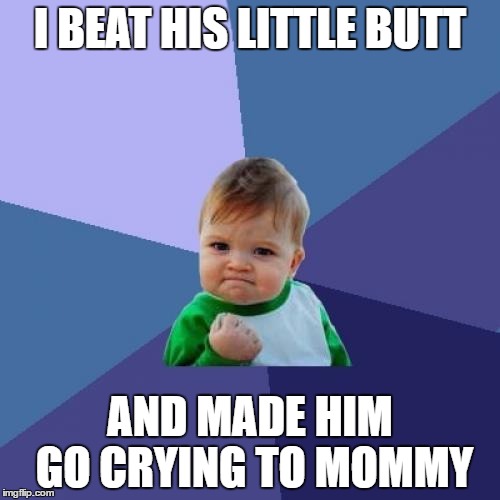
Face it guys...no use being politically correct. That's what we're going for here....
But for now I will leave you with these three things. To all you fellow old guys out there I hope this has been helpful. You are not alone. And it's OK to be bitter no matter that a professional chess coach and common human decency might suggest otherwise. To all the children who might be reading, remember I am dangerous and slightly unhinged. Oh, and to all you chess parents, I wasn't talking about your little angel. Good night.
Subscribe to:
Comments (Atom)